Ask three people what your Rolex is worth and you’ll likely get three different numbers. A listing online says one thing, a friend who sold the same model says another, and the first offer you get is lower than both. None of them is necessarily wrong. They’re answering different questions.
This guide sorts those numbers out, compares the six realistic ways to sell a Rolex in Connecticut, and explains the state rules that protect you when you sell to a business. We’re a dealer, so we’re one of those six options. We’ll be straight about when we’re not the right one.
The short answer: to sell a Rolex in Connecticut, start by finding your reference number and gathering the box, papers and any extra bracelet links. Check what that reference has actually sold for recently, not what sellers are asking. Then get two or three offers. Selling privately online usually nets the most but takes the most time and carries the most risk. A dealer pays less but pays quickly and takes the risk off your hands. A licensed Connecticut buyer must check your photo ID, give you a receipt and pay by check or money order, never cash.
What Your Rolex Is Really Worth
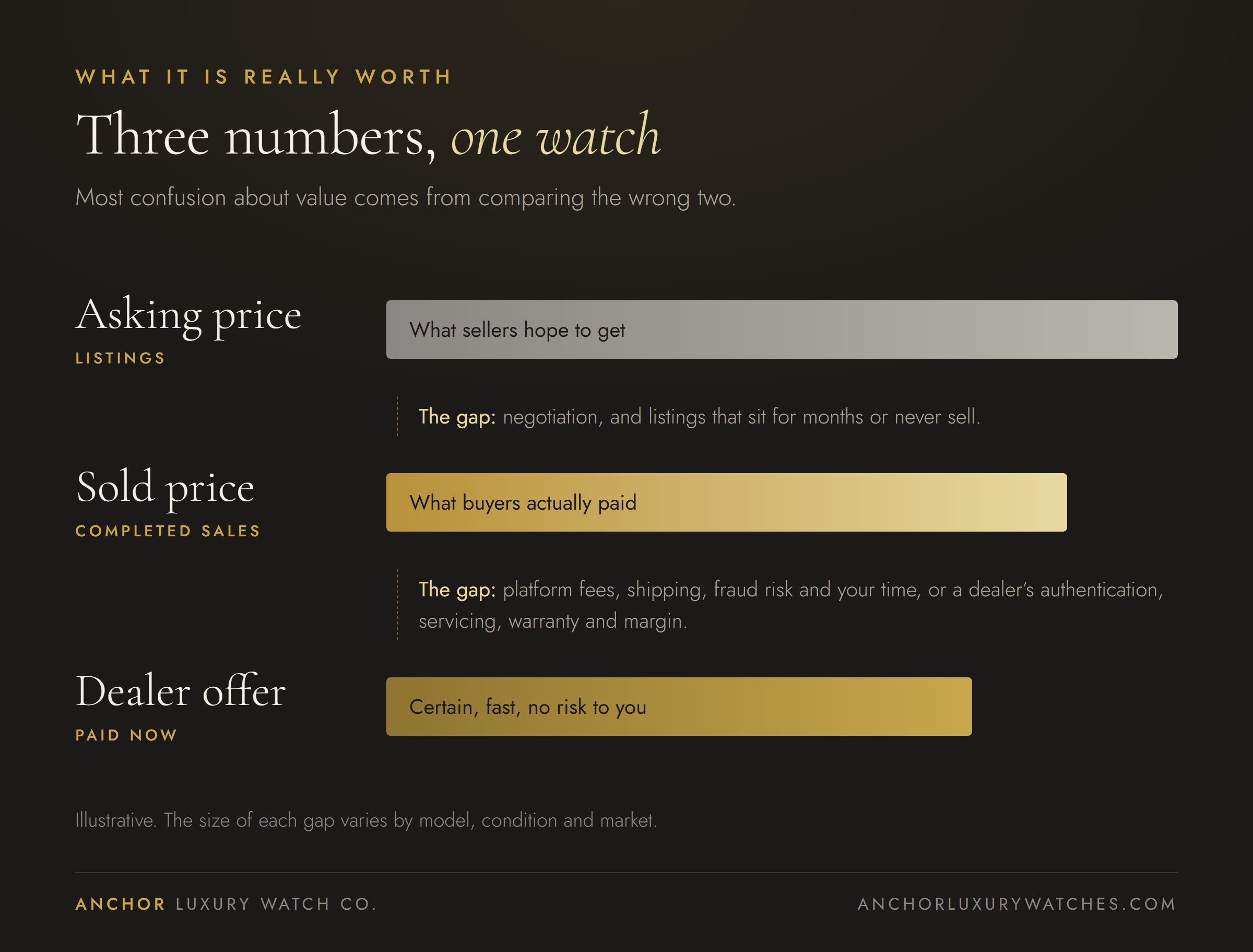
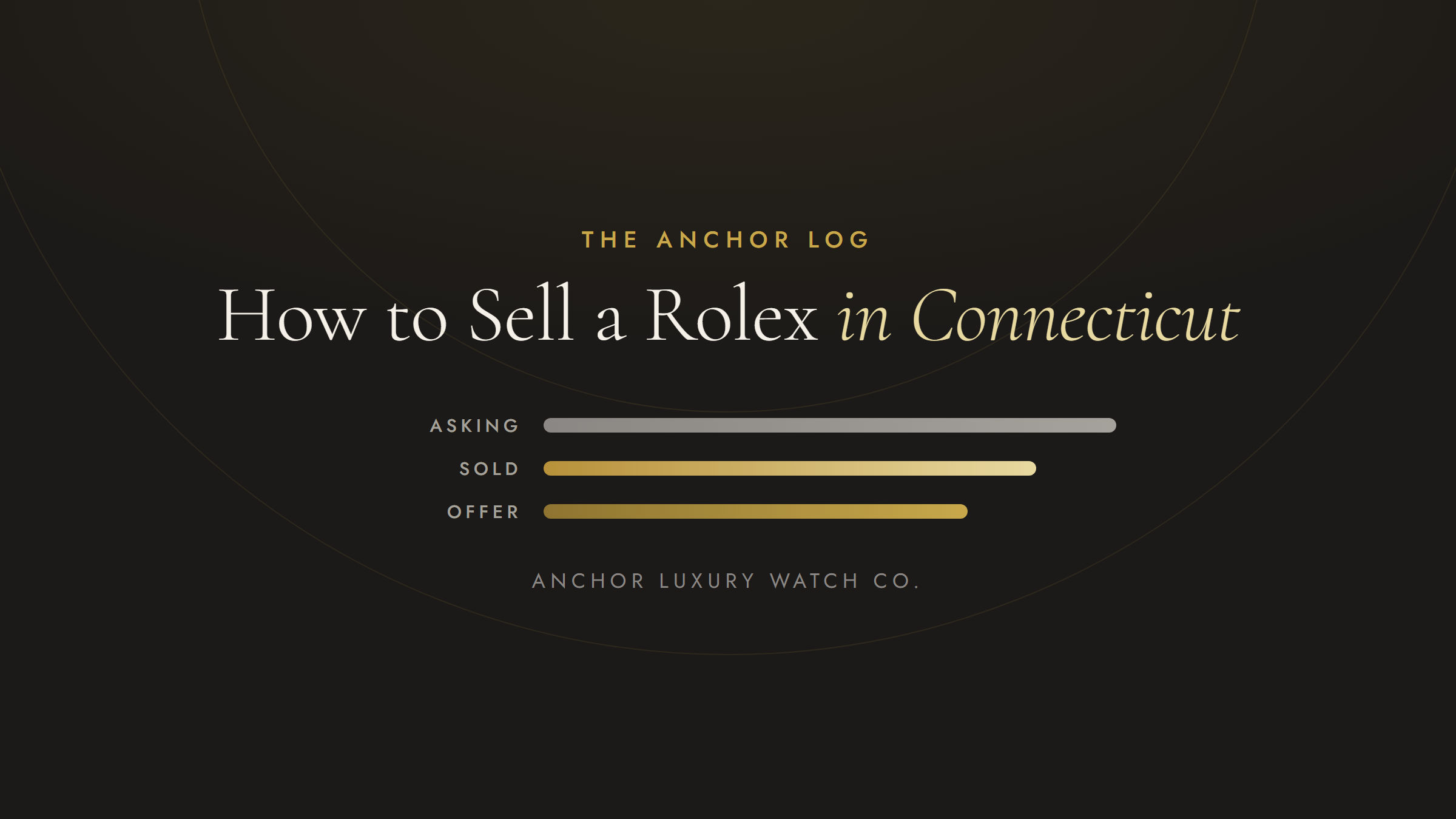
There are three numbers for any watch, and most confusion comes from comparing the wrong two.
- The asking price is what sellers hope to get. It’s what you see first when you search for your model on Chrono24 or a dealer site, and it’s always the highest of the three. Some of those listings sit for months. Some never sell.
- The sold price is what buyers actually paid. This is the honest measure of market value. On eBay you can see it by filtering a search to sold listings. Price trackers that follow completed sales over time are useful too.
- The offer is what a buyer will pay you today, with the money in your hands and none of the selling work left for you to do.
The gap between the sold price and an offer isn’t arbitrary. A private sale carries platform fees, shipping, fraud risk and weeks of your time. A dealer carries the cost of authenticating the watch, sometimes servicing it, warranting it to the next owner and holding it until it sells. The offer prices those in. A fair buyer will walk you through how they got from the market number to theirs.
If you haven’t pinned down exactly which watch you have, start with our guide on how to read a Rolex reference number. Two Submariners can be decades and thousands of dollars apart, and the reference is the only reliable way to tell them apart.
What Moves the Number
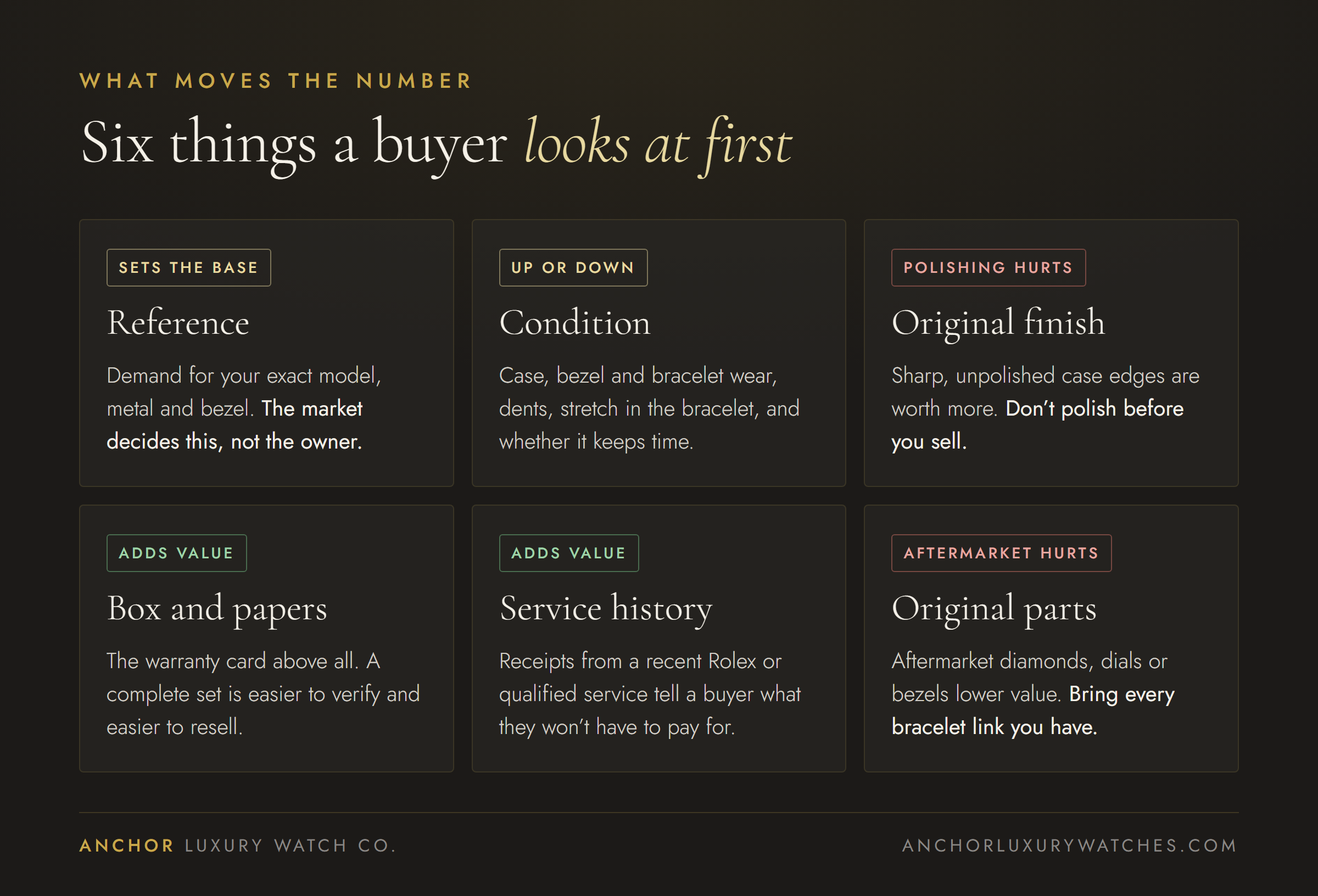
Two watches with the same reference can draw noticeably different offers. Six things account for most of the difference.
- The reference. Demand for your exact model, metal and bezel sets the starting point. The market decides this, not the owner.
- Condition. Scratches, dents, bezel wear, a stretched bracelet, and whether the watch still keeps good time.
- Original finish. Sharp, unpolished case edges are worth more than softened ones. If there’s one rule to remember, it’s this: don’t polish your watch before you sell it. A buyer can’t put metal back.
- Box and papers. The warranty card matters most. A complete set is easier for the next buyer to verify, which makes the watch easier to resell and worth more to a buyer.
- Service history. Receipts from a recent service by Rolex or a qualified watchmaker tell a buyer what they won’t have to pay for.
- Original parts. Aftermarket diamonds, dials and bezels lower value, sometimes sharply. Bring every bracelet link you have, including any that were removed for sizing.
Six Ways to Sell a Rolex in Connecticut
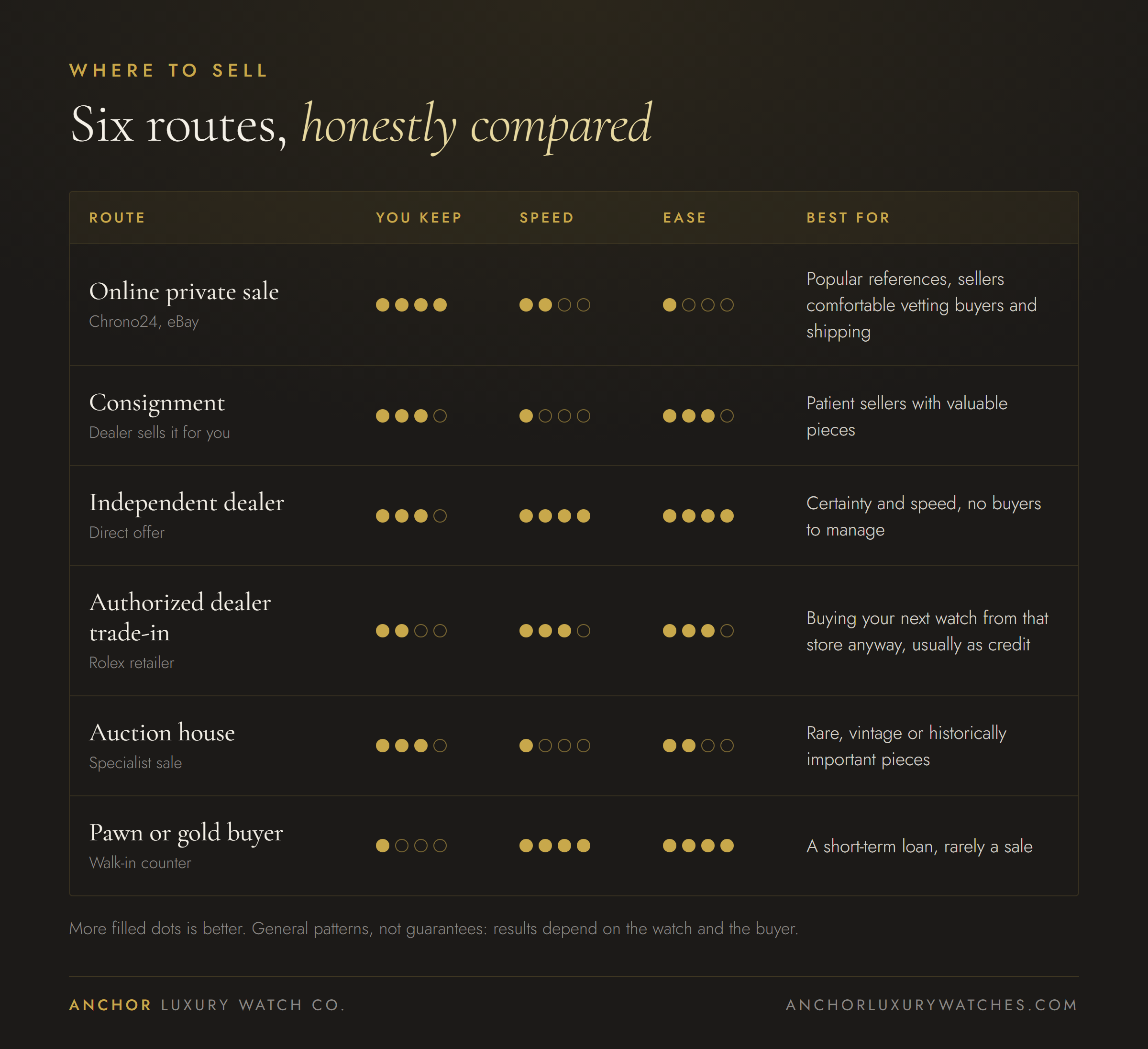
There’s no single best way to sell. There’s a best way for your watch and your patience. Here’s how the options compare.
1. Sell it yourself online
Marketplaces like Chrono24 and eBay usually leave you with the most money, because you’re selling close to the sold price. The fees are real but not large. Chrono24 charges private sellers a 6.5% commission when the watch sells. eBay’s watch fees are tiered, and on a $10,000 sale they come to roughly the same amount, about $650.
The cost is time and risk. You’ll write the listing, field questions and lowball offers, vet the buyer, ship a five-figure item and wait for the sale to settle. It works best for popular references and for sellers who are comfortable doing that work.
2. Consign it
A dealer lists and sells the watch for you and takes a commission when it sells. You get close to market value without managing buyers yourself, but you wait, sometimes weeks and sometimes months, and commissions vary from dealer to dealer. Read the agreement for the commission, the minimum price and how long the watch stays listed.
3. Sell to an independent dealer
A dealer makes you an offer, inspects the watch, and pays you. You’ll usually get less than a private sale would bring, because the dealer takes on the work and the risk. In exchange you get certainty and speed, often the same day or within a few days, with no buyers to manage. Get more than one offer.
4. Trade in at an authorized Rolex retailer
Rolex itself doesn’t buy watches back from the public. Some authorized retailers take trade-ins, usually as credit toward a watch you’re buying from them. If you’re already planning that purchase, it can be convenient. If you want cash, it’s rarely the best route. Call before you go, because policies vary by store.
5. Send it to auction
Major auction houses make sense for rare, vintage or historically important pieces, where a room full of serious bidders can push the price. For a current production steel sport model, the seller’s fees and the months between consignment and payment usually outweigh any benefit.
6. Pawn shops and gold buyers
These are the fastest and the least rewarding. A pawn shop is built for short-term loans, not for paying collector value, and a gold buyer may price the watch closer to its metal. If you need a loan and plan to buy the watch back, pawning can make sense. If you’re selling, look elsewhere first.
Selling to a Business in Connecticut: Know Your Protections
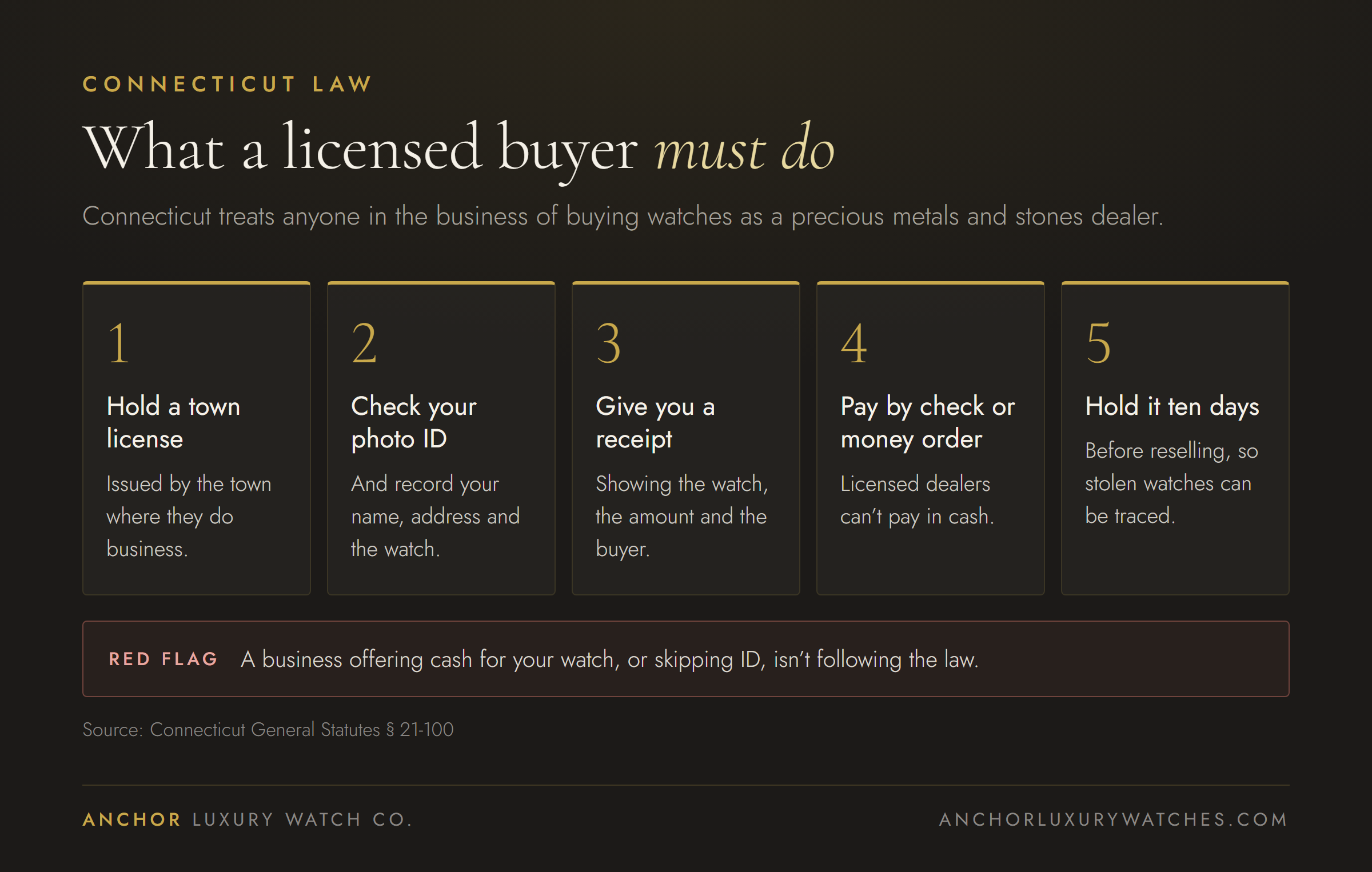
Connecticut treats any business that buys watches as a precious metals and stones dealer. Under Connecticut General Statutes section 21-100, that business must:
- Hold a license from the town where it does business.
- Check your photo ID and record your name, address and a description of the watch.
- Give you a receipt showing the watch, the amount paid and the buyer’s name and address.
- Pay by check or money order. Licensed dealers can’t pay in cash.
- Hold the watch for ten days before reselling it, so a stolen watch can be traced.
Being asked for ID isn’t a hassle to resent. It’s the sign you’re dealing with a buyer who follows the rules. The opposite is the red flag: a business offering cash for your watch, or happy to skip the paperwork, isn’t following the law, and you have to wonder what else it skips.
If You Sell Privately, Protect Yourself
Most private sales go smoothly. The ones that don’t usually fail in predictable ways.
- Use the platform’s payment protection. Chrono24’s escrow holds the buyer’s payment until the watch arrives. On eBay, watches that sell for $2,000 or more in the wristwatch category go through eBay’s Authenticity Guarantee, which inspects the watch before it reaches the buyer.
- Never ship before the money has cleared. Cashier’s checks can be forged, and a check can appear in your account days before your bank discovers it’s bad.
- Walk away from overpayment. A buyer who sends more than the asking price and asks you to refund the difference is running a scam.
- Meet where payment can be verified. For a local sale, a bank lobby lets you confirm the funds before the watch changes hands.
- Document everything. Photograph the watch’s condition before it ships, insure the package for its full value and require a signature on delivery.
Before You Ask for an Offer
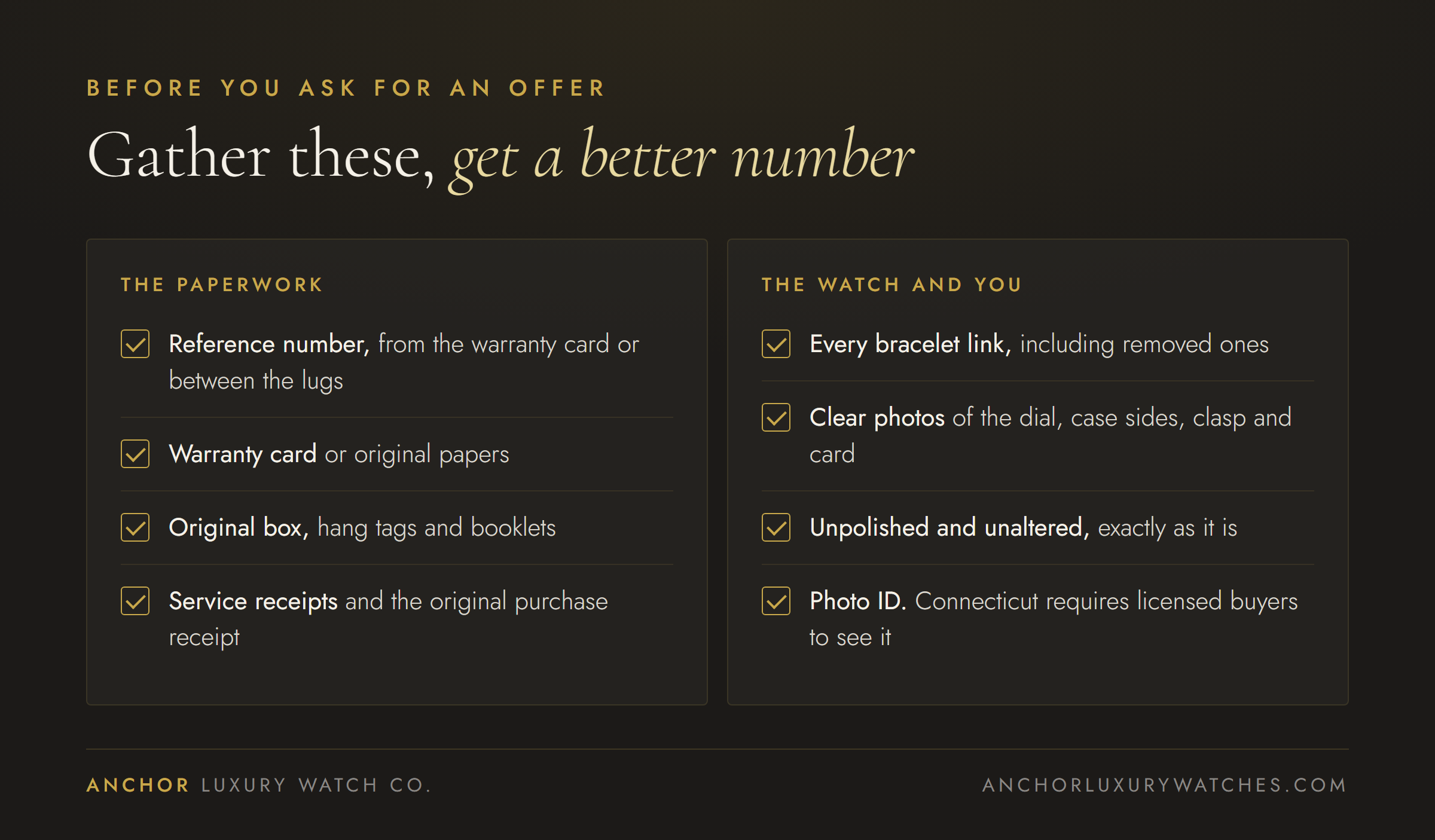
A buyer can only price what they can see. Ten minutes of gathering usually means a firmer, better offer.
- The reference number, from the warranty card or between the lugs at 12 o’clock.
- The warranty card or original papers.
- The original box, hang tags and booklets, even if they seem like clutter.
- Service receipts and the original purchase receipt.
- Every bracelet link, including the ones removed when the watch was sized.
- Clear photos of the dial, both sides of the case, the clasp and the card.
- The watch exactly as it is, unpolished and unaltered.
- Your photo ID, which a licensed Connecticut buyer is required to check.
How Selling to Anchor Works
If you’d like an offer from us, here’s what to expect.
- Send us the basics. The reference number, a few photos and what’s included, such as box, papers and extra links.
- Get a preliminary number. We price every watch against live market data, so we can usually tell you where yours stands quickly, and how we got there.
- Meet in person or remotely. We work by appointment in New London County, or we can handle the sale remotely if that suits you better.
- Inspection and final offer. We authenticate the watch and confirm its condition, then make a firm offer.
- Get paid. With ID, receipt and payment handled the way Connecticut requires.
There’s no obligation at any step, and no pressure if another route makes more sense for your watch. Some sellers would rather put their watch toward another piece, and we can do that too. You can see what’s in our current collection, or start on our concierge page.
Frequently Asked Questions
Do Rolex stores buy used Rolex watches?
Rolex itself doesn’t buy watches back from the public. Some authorized retailers accept trade-ins, usually as credit toward a purchase from their store. If you want cash, an independent dealer or a private sale is usually the better route.
Should I service my Rolex before selling it?
Usually not. A buyer prices the cost of a service into the offer, and paying for one yourself rarely returns its full cost. A full service can also include refinishing the case, which some buyers count against a watch. Sell it as it is, with any service records you already have.
Can I sell a Rolex without the box and papers?
Yes. The watch itself is what gets authenticated, so a watch without its box and papers is still very sellable. Expect a lower offer than for a complete set, because the next buyer will pay less for it too.
How much less than retail will a dealer offer?
There’s no single percentage. The gap depends on the model, its condition, what’s included and how quickly that reference sells. A good buyer will explain how they arrived at their number. If a buyer can’t or won’t, get another offer.
Is it safe to sell a Rolex on eBay or Chrono24?
It can be, if you use the platform’s protections. Use Chrono24’s escrow or eBay’s checkout, never ship before payment has cleared, and treat any request to refund an overpayment as a scam.
Do I need ID to sell a watch in Connecticut?
Yes, when you sell to a business. Connecticut law requires licensed watch buyers to check a photo ID that shows your address and an identifying number, and to give you a receipt for the sale.
The Number That Matters
The asking price makes for good daydreaming, and the first offer can feel like a letdown. The number that matters is the sold price for your exact reference, and how close each route gets you to it once you count fees, time and risk.
Have a watch you’re thinking about selling? Send Ryan the reference and a few photos. We’ll tell you where it stands, even if the honest answer is that a private sale would serve you better.