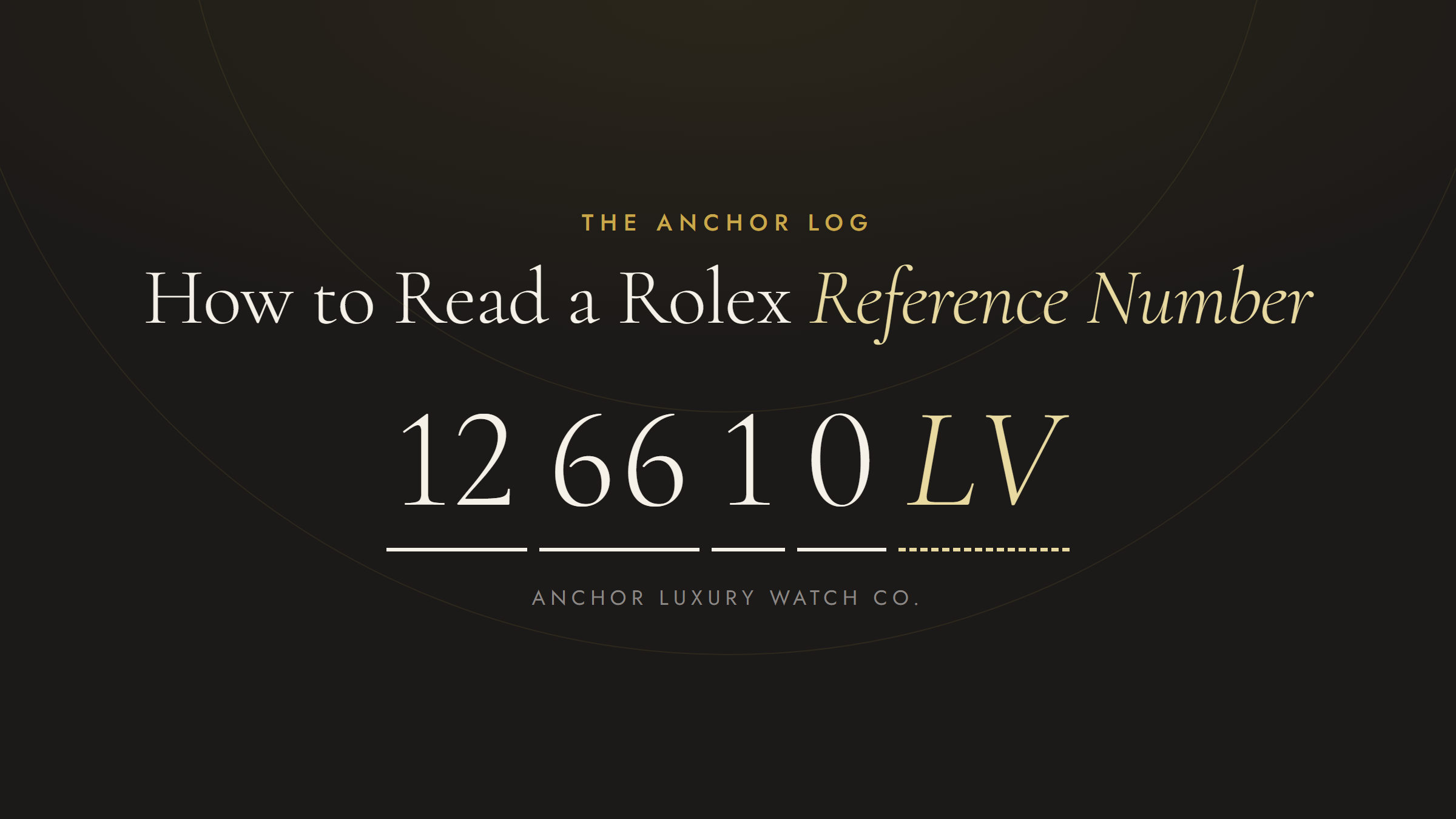
126610LV. To most people that’s a string of characters. To anyone who knows the code, it’s a steel Submariner Date with a green ceramic bezel, the current generation, the one collectors call the “Starbucks.” Rolex packs all of that into a single reference. Not every reference looks like this one: some end in four letters, and many have none at all. The logic underneath is the same, and once you can read it, you can size up a watch before you’ve seen a single photo.
This guide walks through the code one piece at a time. It also covers where the system breaks, because it does, and how to use a reference number to check a listing before you buy or get an accurate offer when you sell.
A note on scope: this guide covers modern Rolex references, the five- and six-digit numbers used since the 1980s. Vintage four-digit references follow looser rules of their own.
The short answer: a current Rolex reference has six digits, often followed by two to four letters, and sometimes none. Read the digits in four parts, then the letters if there are any. The first two digits are the generation. The next two are the model family. The fifth is the bezel style or a variant. The last digit is the metal. The letters, when there are any, describe the bezel, abbreviated in French. In 126610LV: 12 is the current generation, 66 is the Submariner Date, 1 is its bezel code, 0 is Oystersteel, and LV means Lunette Verte, a green bezel.
Reference Number vs. Serial Number
These are two different numbers, and they answer two different questions.
The reference number tells you what the watch is. Every steel Submariner Date with a green bezel made today carries 126610LV. Thousands of watches share it.
The serial number tells you which one you’re holding. It is unique to a single watch, like a VIN on a car.
Since late 2010, Rolex has issued serial numbers in a randomized format, so a modern serial no longer reveals the production year on its own. For a recent watch, the date on the warranty card is the reliable record of when it was sold. The reference, by contrast, tells you which generation the watch belongs to, which narrows the age more than most people expect.
Where to Find the Reference Number
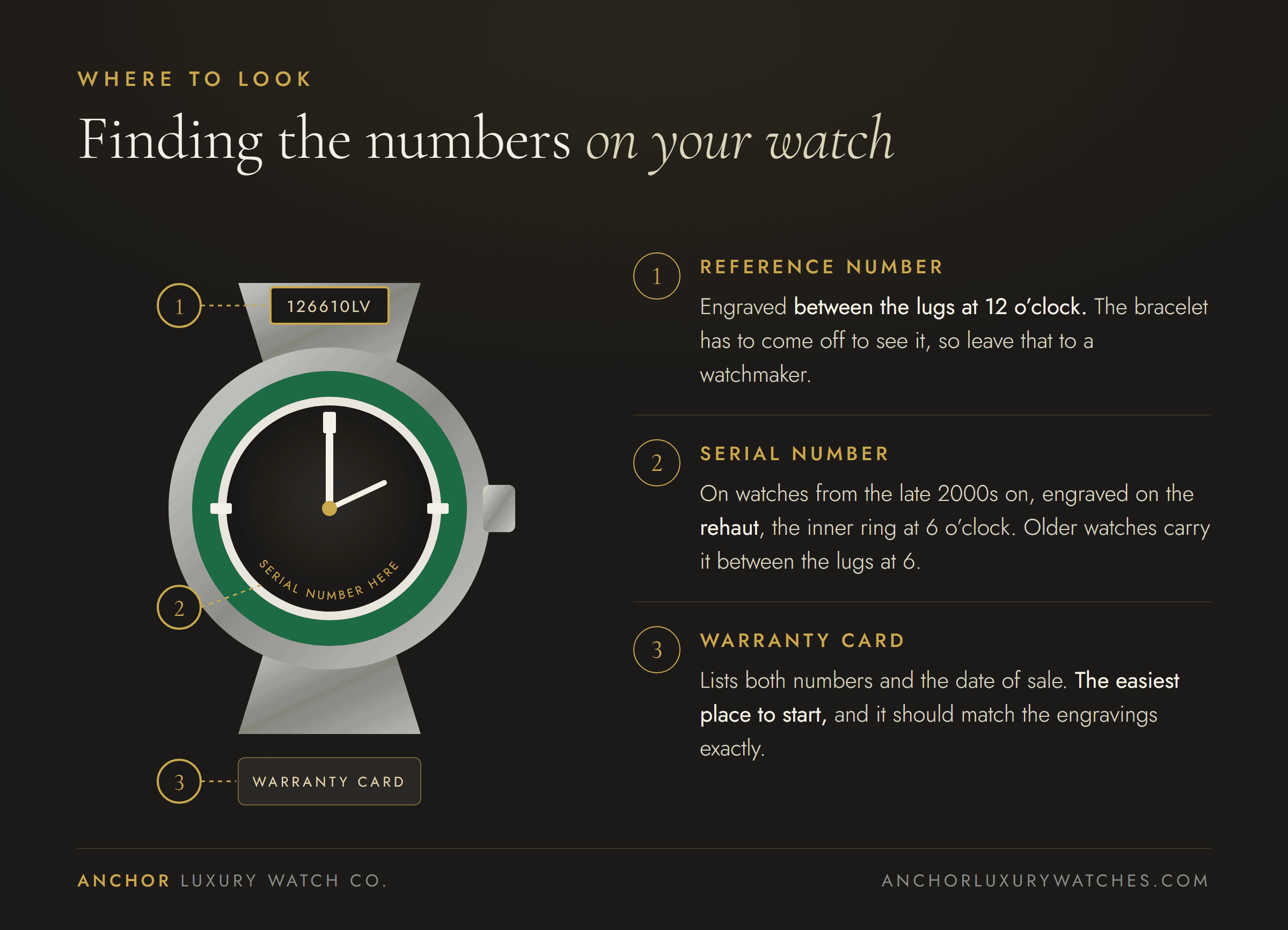
There are three places to look.
- The warranty card. The easiest place to start. It lists the reference, the serial, and the date of sale.
- Between the lugs at 12 o’clock. The reference is engraved on the case, under the bracelet. The bracelet has to come off to read it, which is a job for a watchmaker with the right tools, not a kitchen table.
- The rehaut, for the serial. On watches from the late 2000s onward, the serial is engraved on the rehaut, the inner ring between the dial and the crystal, at 6 o’clock. Older watches carry it between the lugs at 6.
The card and the engravings should match exactly. When they don’t, that is the first question to ask, not the last.
Reading a Modern Reference
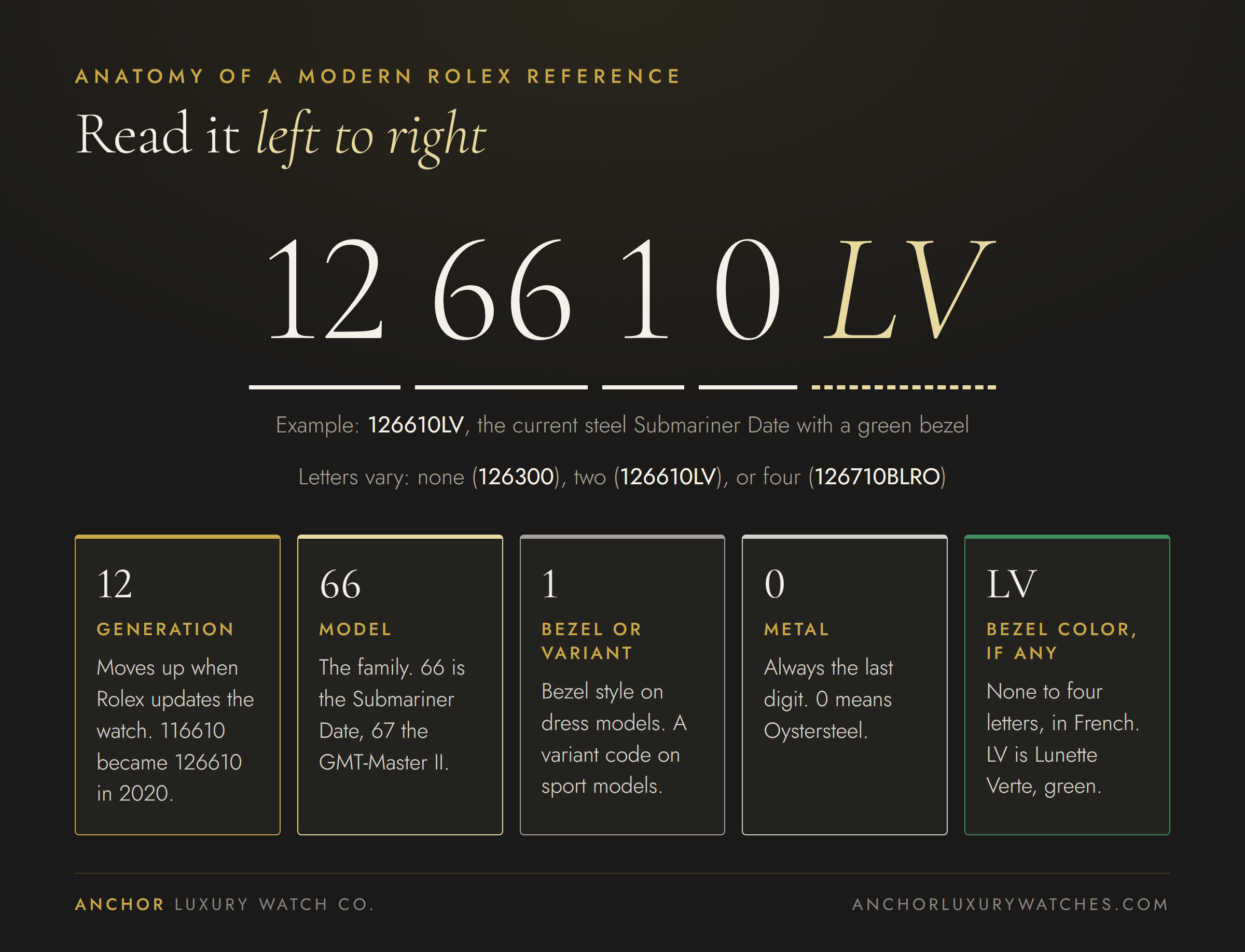
Read the six digits left to right in four parts. Then read the letters, if the watch has any.
1. The first two digits: generation
The leading digits change when Rolex rebuilds a watch with a new case or movement. The Submariner Date was 116610 from 2010. When it moved to a 41 mm case and the calibre 3235 in 2020, it became 126610. Same model, same bezel, same metal. The 11 became 12, and that single digit tells you which generation you’re looking at.
2. The next two digits: the model
This pair identifies the family. 66 is the Submariner Date. 67 is the GMT-Master II. 62 is the Datejust 36, and 63 is the Datejust 41. You don’t need to memorize the full list. After a few weeks of browsing, the common ones stick on their own.
3. The fifth digit: bezel style or variant
On dress models like the Datejust and Day-Date, this digit describes the bezel. In the Datejust 36 and 41, a 0 means a smooth bezel and a 3 means fluted. On sport models it usually separates variants within a family. The clearest example is the GMT-Master II: 126710 has the crown on the right, while 126720 is the left-handed version with the crown on the left.
4. The last digit: the metal
This is the most useful digit in the whole number, and the one worth committing to memory. It gets its own section below.
5. The letters: bezel color, if there is one
Letters after the number describe the bezel insert, abbreviated from French. How many letters there are tells you something on its own:
- Two letters name a one-color bezel. LN is Lunette Noire, a black bezel.
- Four letters name a two-color bezel. BLRO is Bleu Rouge, the blue and red “Pepsi.”
- No letters usually means a metal bezel, with nothing to color-code. The Datejust 41 in 126300 and the Oyster Perpetual 41 in 134300 carry no suffix at all.
- Gem-set models use their own codes, such as RBR on diamond-set pieces.
The full list of bezel color codes is further down.
One correction worth making here: some guides describe the fifth digit as the metal and the sixth as the bezel. It’s the other way around. The metal is always the final digit. A Day-Date 40 in reference 228235 has a fluted bezel (the 3) in Everose gold (the 5). Swap them and you’d misread the watch entirely.
The Metal Code: What the Last Digit Means
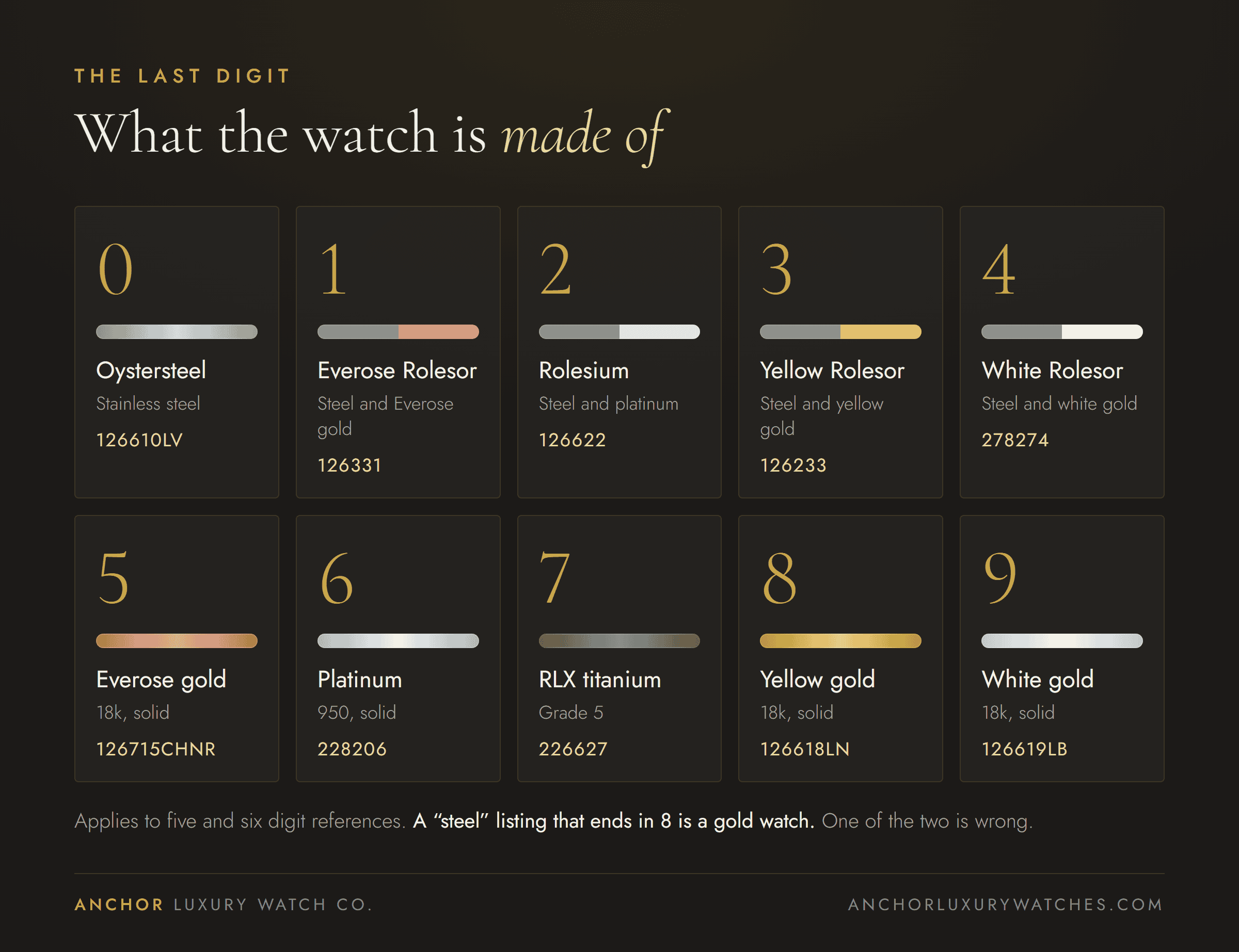
For five- and six-digit references, the final digit tells you what the case is made of.
- 0 Oystersteel. Rolex’s stainless steel. Example: 126610LV.
- 1 Everose Rolesor. Steel and Everose gold. Example: 126331.
- 2 Rolesium. Steel and platinum. Example: 126622.
- 3 Yellow Rolesor. Steel and yellow gold. Example: 126233.
- 4 White Rolesor. Steel and white gold, usually a white gold bezel on a steel watch. Example: 278274.
- 5 Everose gold. Solid 18k. Example: 126715CHNR.
- 6 Platinum. Solid 950 platinum. Example: 228206.
- 7 RLX titanium. Rolex’s grade 5 titanium. Example: 226627.
- 8 Yellow gold. Solid 18k. Example: 126618LN.
- 9 White gold. Solid 18k. Example: 126619LB.
This is where the reference earns its keep. A listing described as “steel” whose reference ends in 8 is describing a solid gold watch, and one of those two facts is wrong. A “two-tone” watch ending in 0 isn’t two-tone. You can catch a mismatch in seconds without looking at a single photo.
A note on vintage: four-digit references predate this system and don’t follow it reliably. The list above is for five- and six-digit references.
The Letters: Bezel Colors in French
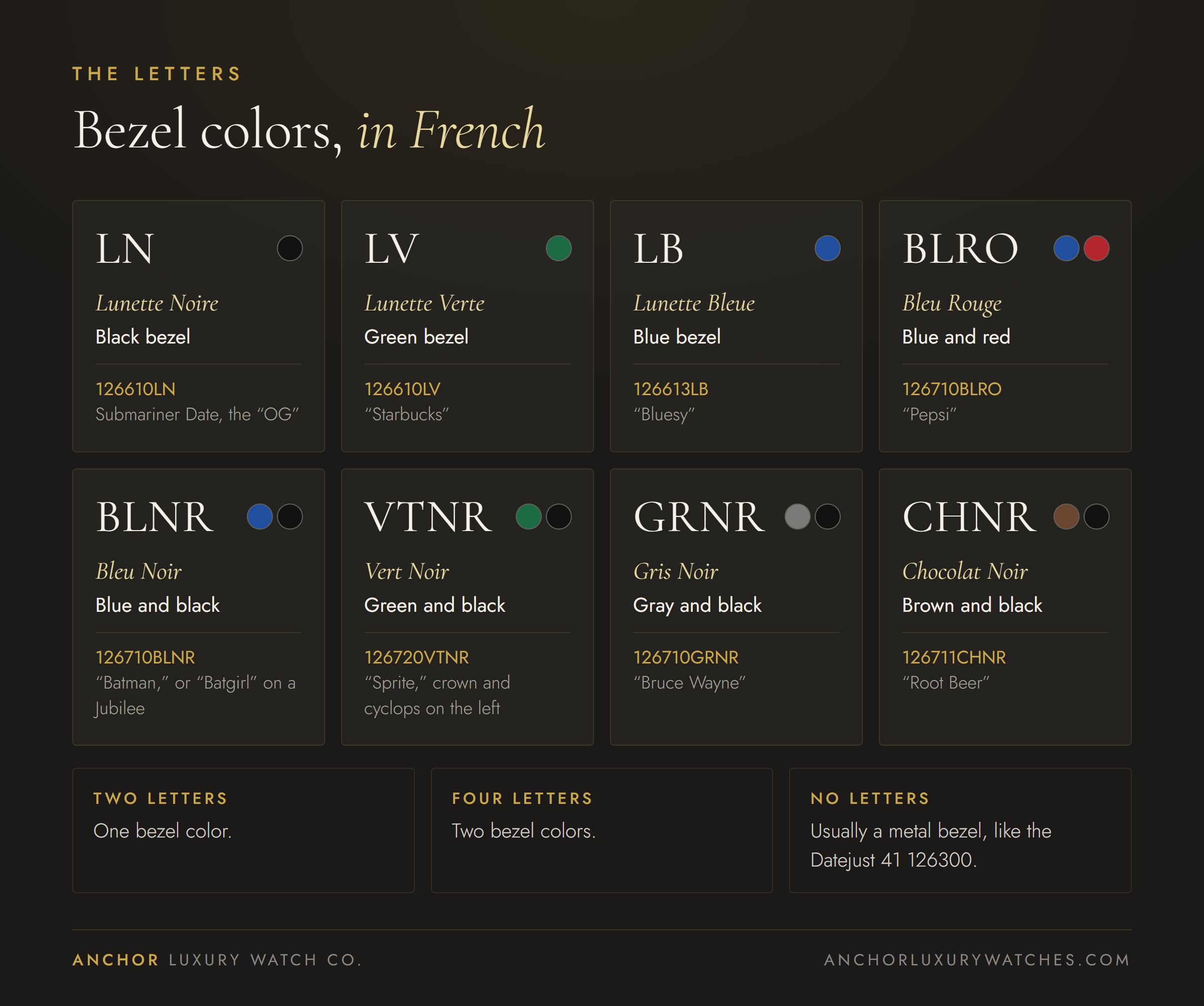
Rolex abbreviates bezel colors from French. Single-color bezels start with L for lunette, the French word for bezel. Two-color bezels list both colors.
- LN, Lunette Noire. Black bezel. 126610LN, the Submariner Date collectors call the “OG.”
- LV, Lunette Verte. Green bezel. 126610LV, the “Starbucks.”
- LB, Lunette Bleue. Blue bezel. 126613LB, the “Bluesy.”
- BLRO, Bleu Rouge. Blue and red. 126710BLRO, the “Pepsi.”
- BLNR, Bleu Noir. Blue and black. 126710BLNR, the “Batman,” or the “Batgirl” on a Jubilee bracelet.
- VTNR, Vert Noir. Green and black. 126720VTNR, the “Sprite,” with its crown and cyclops on the left.
- GRNR, Gris Noir. Gray and black. 126710GRNR, the “Bruce Wayne.”
- CHNR, Chocolat Noir. Brown and black. 126711CHNR, the “Root Beer.”
Nicknames come from collectors, not Rolex, and they can follow the letters from one generation to the next or not. The previous-generation 116610LV had a green dial and a green bezel, and collectors called it the “Hulk.” The current 126610LV kept the LV but switched to a black dial, and the nickname changed to “Starbucks.” Same letters, different watch. That is why the digits in front of the suffix matter.
One Watch, Four References
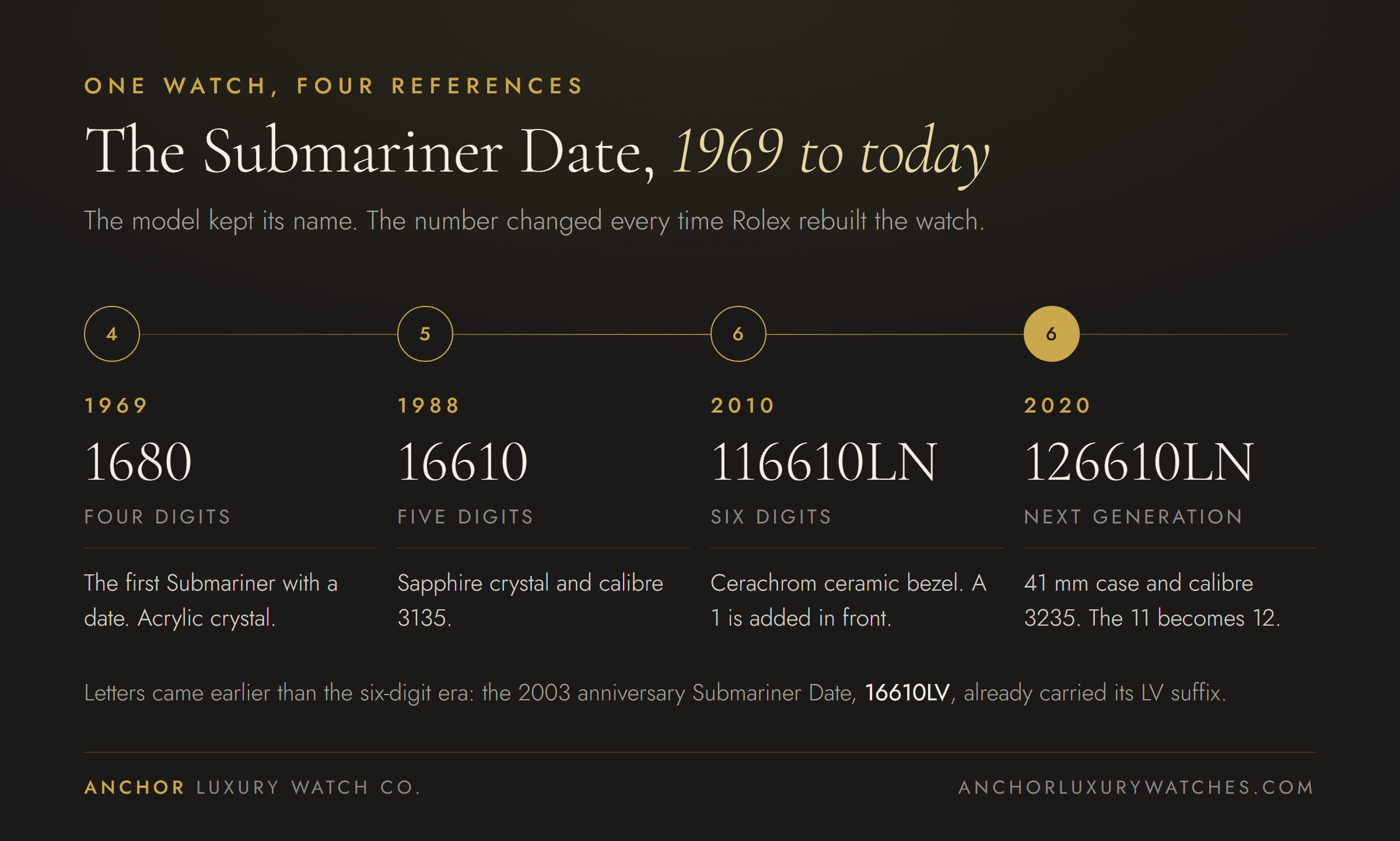
The clearest way to see how the numbering grew is to follow one watch through its history. The Submariner Date has carried four references in five decades.
- 1680, from 1969. The first Submariner with a date. Four digits, acrylic crystal.
- 16610, from 1988. Five digits. Sapphire crystal and the calibre 3135.
- 116610LN, from 2010. Six digits, with a 1 added in front, and the Cerachrom ceramic bezel.
- 126610LN, from 2020. The current generation. A 41 mm case and the calibre 3235. The leading 11 becomes 12.
Letters came earlier than the six-digit era. The 2003 anniversary Submariner Date, 16610LV, already carried its LV suffix, years before 116610LN.
The model name never changed. The number did, every time the watch was rebuilt. When someone says “a Submariner Date,” the reference is the only thing that tells you which one they mean, and the difference between generations can be significant in both character and price.
Where the System Breaks
Rolex’s numbering is logical, not perfect. A few exceptions are worth knowing before you lean on the rules too hard.
The bezel digit doesn’t carry across families. In the Datejust 36 and 41, a 3 in the fifth position means fluted. The Datejust 31 uses its own numbers: our 278274 has a fluted white gold bezel, and the digit in that position is a 7.
The same middle digits can mean different watches. The Daytona and the Explorer II have both used 65 in the model position over the years. The fifth digit separates them. Read the whole number, not a fragment of it.
Dash numbers aren’t a code. Rolex’s own catalog adds a suffix like -0001 or -0002 to separate configurations that share a reference, such as dial color or bracelet. There is no fixed meaning behind them. On the Pepsi GMT-Master II, 126710BLRO-0001 is the Jubilee bracelet and -0002 is the Oyster, which is the opposite of what most people would guess. Look them up rather than assuming.
Gem-set and special pieces add their own letters. References for diamond and gem-set models carry additional suffixes that go beyond bezel color. When you see one you don’t recognize, treat it as a question for the dealer, not a detail to skip.
Practice on What’s in Our Collection
The best way to make the code stick is to use it on real watches. Here are a few from our current collection, decoded.
- 126233. 12 is the current generation, 62 is the Datejust 36, 3 is the fluted bezel, and the final 3 is Yellow Rolesor, steel and yellow gold.
- 278274. The Datejust 31, with its own bezel numbering (7 for fluted), and a final 4 for White Rolesor, steel with a white gold bezel.
- 126720VTNR. GMT-Master II, current generation, steel. The 2 in the fifth position is the left-handed case, and VTNR is the green and black bezel.
- 126710GRNR. GMT-Master II, current generation, steel, with the gray and black GRNR bezel.
- 126610LV. You know this one by now.
You can see every piece we have in on our inventory page, with the full live catalog and current pricing on WatchTrack.
Using the Reference When You Buy
A reference number is the fastest honesty check in the watch business. Before you look closely at condition, confirm that four things agree:
- The listing’s description and the last digit. Steel should end in 0. Two-tone should end in 1, 2, 3, or 4. Solid gold should end in 5, 8, or 9.
- The photos and the suffix. An LN reference should show a black bezel. A BLRO should show blue and red. If the bezel in the photos doesn’t match the letters, ask why.
- The warranty card and the engraving. The reference and serial on the card should match what is engraved on the case.
- The generation and the details. A 12-generation reference should show the features of that generation, not parts from an earlier one.
A mismatch doesn’t always mean something dishonest. Service replacement parts and simple typos happen. But every mismatch deserves an answer before money changes hands. Checking these details is the first step of how we authenticate every watch we carry, and it’s a step you can do yourself.
Using the Reference When You Sell
If you’re thinking about selling or trading, the reference is the first thing a dealer needs. “A steel Submariner” could describe watches decades and many thousands of dollars apart. “126610LN with box and papers from 2022” gets you a real number.
To get an accurate offer, have these ready:
- The full reference number, including any letters
- The warranty card, or a photo of it
- Whether you have the original box and papers
- A few clear photos of the dial, bezel, and case
Send those along and we’ll come back with a transparent, market-accurate offer, in person or remote. Start on our concierge page or contact Ryan directly.
Same Idea, Other Brands
Rolex isn’t the only brand that encodes a watch in its reference. Omega’s system is even more literal. The Speedmaster Moonwatch in our collection, 310.30.42.50.01.002, reads in six groups:
- 310: the collection, here the Speedmaster Moonwatch Professional
- 30: the case material code
- 42: the case diameter in millimeters
- 50: the movement type
- 01: the dial color, 01 being black
- 002: Omega’s sequence number for the specific version. On the current Moonwatch, .001 is the Hesalite crystal version and .002 is the sapphire version.
Tudor, Rolex’s sister brand, uses modern references that begin with M and end with a dash number for the specific configuration, like the M7941A1A0RU-0002 Black Bay we’ve carried. The logic of the letters differs from Rolex’s, so it’s worth reading Tudor’s catalog listing rather than applying Rolex rules.
Frequently Asked Questions
What is a Rolex reference number?
A Rolex reference number is the model code engraved between the lugs at 12 o’clock and printed on the warranty card. Modern references have six digits and sometimes letters, and they identify the generation, model, bezel style, metal, and bezel color. Every watch of the same model shares the same reference.
What does the last digit of a Rolex reference mean?
The last digit is the metal. 0 is Oystersteel, 1 is Everose Rolesor, 2 is Rolesium, 3 is Yellow Rolesor, 4 is White Rolesor, 5 is 18k Everose gold, 6 is platinum, 7 is RLX titanium, 8 is 18k yellow gold, and 9 is 18k white gold.
What does LN mean on a Rolex?
LN stands for Lunette Noire, French for black bezel. It appears on references like the Submariner Date 126610LN. Other suffixes follow the same pattern: LV is a green bezel, LB is blue, and two-color bezels like BLRO list both colors.
Why do some Rolex references have four letters?
Four letters describe a two-color bezel, two letters for each color. BLRO is Bleu Rouge, blue and red. BLNR is Bleu Noir, blue and black. You’ll see four-letter suffixes most often on the GMT-Master II, whose bezels are split between day and night colors.
Why doesn’t my Rolex reference have any letters?
Many references carry no suffix at all, usually because the watch has a metal bezel rather than a colored insert. A Datejust 41 in 126300, an Oyster Perpetual 41 in 134300, or a Day-Date 40 in 228238 is complete as six digits. No letters doesn’t mean anything is missing.
Can a reference number tell me what year my Rolex was made?
Not exactly. The reference tells you the generation, which narrows the range. For watches made after late 2010, the serial number is randomized and doesn’t reveal the year either. The date on the warranty card is the most reliable record for a modern watch.
What’s the difference between a reference number and a serial number?
The reference number identifies the model and is shared by every watch of that model. The serial number is unique to one individual watch. The reference is engraved between the lugs at 12 o’clock. On modern watches, the serial is engraved on the rehaut at 6 o’clock.
Do I need to remove the bracelet to find the reference?
To read the engraving on the case, yes. Most owners don’t need to. The warranty card lists the reference, and a watchmaker or dealer can confirm the engraving during an inspection.
Know the Number, Know the Watch
126610LV started this article as a string of characters. Now it’s a current-generation steel Submariner Date with a green bezel, and you can read the next reference that crosses your path just as quickly.
If you have a specific reference in mind, whether you’re looking for one or thinking about letting one go, send it to Ryan. We’re by appointment in New London County, and every conversation starts with the number.